Widespread Reactions to Deleted Okaz Article on Yemeni Leadership Remaining Abroad
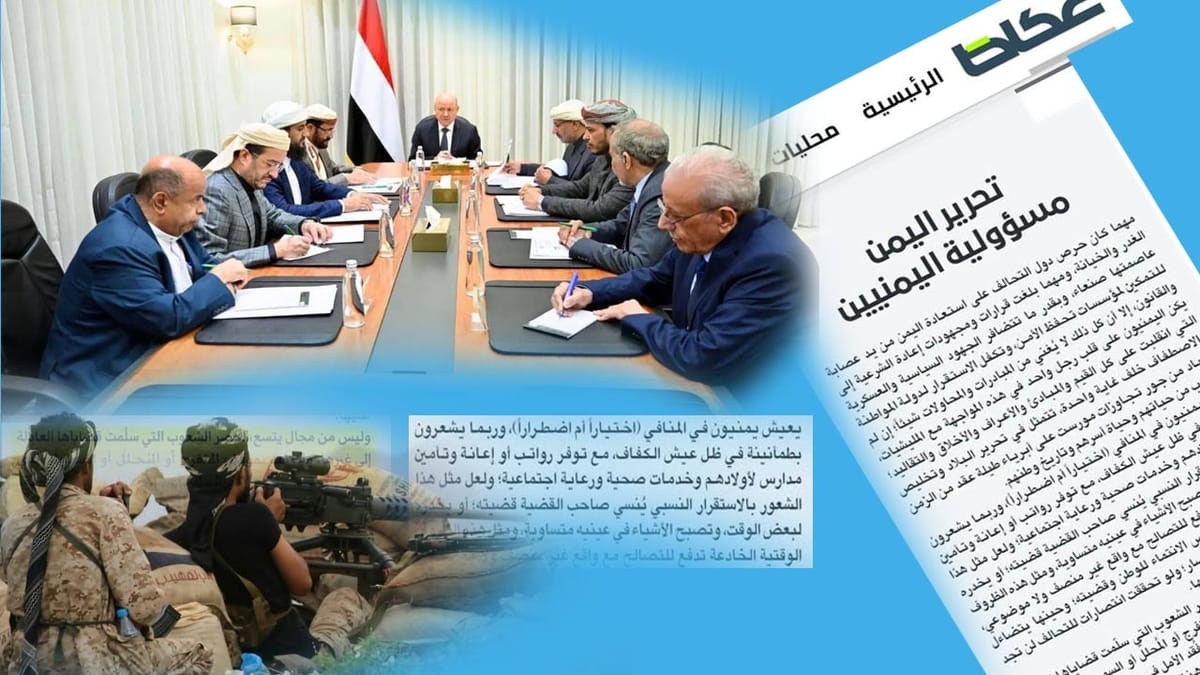
The Saudi newspaper «Okaz» has reignited the debate about the importance of the Yemeni leadership taking responsibility for ending the state of war and establishing peace with its article published on Wednesday, titled «Liberating Yemen is the Responsibility of Yemenis», which it later deleted.
In its article, Okaz newspaper said that the coalition's efforts will not achieve their goals without unifying ranks, and criticized what it called "the sense of security among Yemenis living in exile, living a meager existence with salaries or aid, secured schools for their children, health services, and social care."
It continued: Perhaps such a feeling of relative stability makes the one with a cause forget their cause, or numbs them for a while, and things become equal in their eyes. Such deceptive, temporary circumstances push them to reconcile with an unfair and non-objective reality that, cumulatively, weakens the sense of belonging to the homeland and its cause. Then, the hope of achieving any victory diminishes; even if victories were achieved for the coalition, they would find no one to reinforce or maintain them."
The newspaper continued its implicit attack on the legitimate leadership, saying: "If all segments of Yemeni society do not feel that liberating Yemen is everyone's responsibility, then the strenuous efforts are at risk of being wasted. As the old proverb says, «The village's pillar is its master; the rest of the people are just scarecrows».
The article quickly turned into a wide-ranging political and media movement, especially as it was the first of its kind to speak with such boldness and frankness, after years of repeated talk about the necessity of the legitimate leadership's return and stabilization in Yemen, and the cessation of privileges and funds allocated to officials abroad.
Okaz's deleted article resonated within the political, journalistic, and activist circles in Yemen, who wrote on social media platforms expressing their views and analysis of the article's content, timing, and purpose, as well as the prospects for future Saudi interest in the Yemeni file.
Tribal leader and Shura Council member, Al-Hassan Abkar, responded on his Facebook account to the Saudi newspaper's article, saying: You cannot ask Yemenis to liberate their country while the will for liberation remains hostage to a few who neither benefit their homeland nor even serve those who support them, and who are only concerned with preserving their positions and interests. Indeed, these individuals have become the biggest obstacle to anyone who wants to participate in restoring the state, whether militarily, politically, financially, or intellectually.
He continued, addressing Saudi Arabia: You are the ones who give these people cover and provide them with the means of comfort and survival, while restrictions are imposed on those who want to act and participate.
Abkar said: The responsibility of liberating Yemen is not reduced to demanding Yemenis fulfill their national duty, but begins with empowering them to exercise this duty. Those who cannot return to participate, cannot deliver their support, and find no way to contribute their opinion or effort should not be blamed for an inability that restrictions helped create. And whoever monopolizes decision-making and obstructs initiatives should not be exempted from responsibility and have it placed on those who do not hold power in the first place."
He continued: If liberating Yemen is the responsibility of Yemenis, then empowering them to liberate it is the responsibility of everyone who has the ability to open the way for them, lift restrictions on them, and end the guardianship over their decisions. The issue is not that Yemenis have forgotten their country, but that those who demand they liberate it are first required to remove the obstacles preventing their participation and to hold accountable those who monopolize decisions and obstruct the will for liberation.
Journalist Salah Al-Qaedi wrote: The Saudi newspaper Okaz in its editorial launches an attack on Yemenis in exile who it says feel secure, with salaries or aid, schools for their children, and health and social care; stressing that such a feeling of relative stability makes the one with a cause forget their cause, or numbs them for a while, and things become equal in their eyes.
Journalist Mohammed Al-Khameri called on the legitimate leadership in Riyadh to read the Saudi Okaz newspaper's editorial very carefully because it is like a red card, and they should get their act together quickly before they receive notice from the hotel management that their hospitality and paid accommodation are ending.
He added: "Okaz newspaper said in its clear message to the Yemeni leadership: There is no room to list the peoples who handed over their just causes to others, and were content with the position of a spectator or a broker-analyst who plays like a puppet on all strings until hope was lost for the state's return, or the liberation of the homeland from occupation."
Al-Khameri considered that "the last paragraph of the editorial, which was deleted from the website, could not have been published without permission or direction from high authorities; pointing to its content: If all segments of Yemeni society do not feel that liberating Yemen is everyone's responsibility, then the strenuous efforts are at risk of being wasted. As the old proverb says, «The village's pillar is its master; the rest of the people are just scarecrows».
On the contrary, journalist Abdullah Dubla attacked the newspaper, saying: "An article that expresses the scum of Okaz... and the Emirati penetration of Riyadh. I don't know why this celebration of triviality, which stems only from a base sense of inferiority."
He added: "I know that many are not comfortable with the Yemeni leadership, and I am one of them, but the responsibility for the situation is shared with Saudi Arabia, and this is not the time to assign blame. And I think the Saudis were wise to delete it."
Dubla wrote: The Saudi leadership does not need to start a media battle with Rashad al-Alimi through Okaz or the media in general... His political decision is almost identical to theirs... And in the current context of the war, the last thing Saudi Arabia needs is to adopt the Houthi discourse against the legitimate government.
He continued: "Okaz is a private and poor-quality newspaper, similar to many shallow newspapers we have in Yemen. If we rule out stupidity as a motive for the article, then the motives of serving the Houthis and the UAE are possible probabilities."
He said: I know that this discourse resonates with many people, and many are right to feel that way, but many of those who promote the article, whom I know, have petty grudges with the legitimate government over not getting a position or a stipend. This is a known behavior of the selfish Yemeni character that has led the country to its current state, where public issues are brought up and chewed over for very small and vile purposes.
Journalist Abdullah Dubla concluded his article by saying: What concerns me is to express my belief that the article does not represent the Saudi leadership, and I also want to make it clear to some fools that my motive for this is simply a situational assessment, and I am not one of those who receive illicit stipends from the legitimate government or others.
Journalist Amer Al-Dumaini considered the deleted article from the Saudi newspaper Okaz as an indicator that many leaders must understand and comprehend.
Al-Dumaini shared a picture of the article and wrote: "In truth, such things should not have been said, as it is completely inconsistent with the current developments of the confrontation."
Journalist Samir Al-Salahi said: "For the first time in 12 years, the Saudi newspaper Okaz is attacking the leaders of the legitimate government (the 'hotel-dwellers') outside the country, asserting that their sense of relative stability, high salaries, and secured health care has made them forget their cause and their homeland, noting that maintaining the coalition's victories on the ground will be difficult as long as the legitimate leadership is outside the country."
He added: "When the 'hotel-dwelling' leaders of the legitimate government did not understand the messages from our Saudi activist brothers in Twitter Spaces over the past two months, Okaz newspaper today repeated the same story for them, hoping they might leave the hotels and get the message..!"
He continued: "Okaz explicitly asked them not to be like brokers playing all sides. We have a popular proverb that says: 'Beat the packsaddle, and the donkey will understand.' Today, Okaz beat the donkey itself, and hopefully, they will understand and return to their country before it's too late.
المصدر: Almahriah Net + Social Media