Mecca Agreement Stirs Regional Objections: Emirati Doubts, Houthi Rejection, Israeli Concerns, and Iranian Reservations
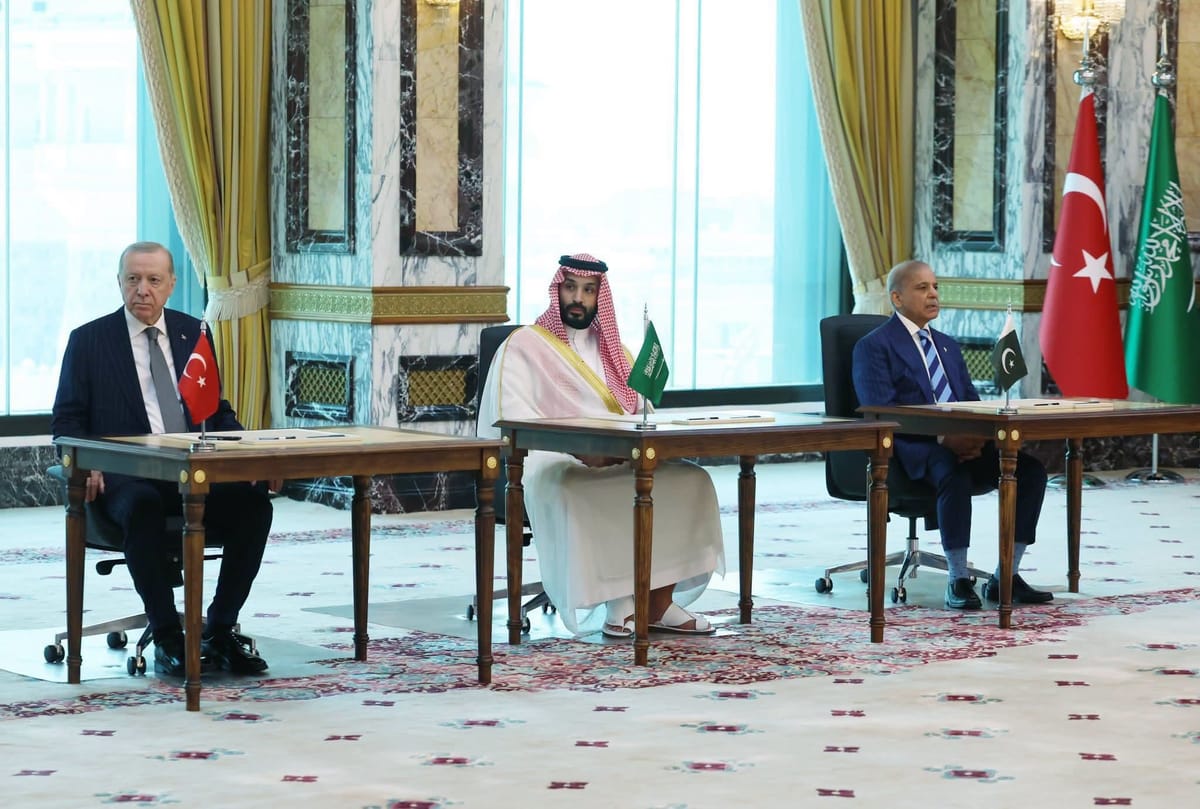
The joint defense agreement signed by Saudi Arabia, Turkey, and Pakistan in Jeddah has sparked mixed reactions from some countries and groups, ranging from questioning the new alliance's feasibility and warning of its repercussions, to considering it an indicator of a reshaping of regional power balances.
While Riyadh presented the agreement as a framework for enhancing defense cooperation and collective security, objections arose from the UAE, the Houthis, and Iran. Meanwhile, Israeli media coverage reflected fears that the agreement could bolster the deterrence capabilities of regional parties far from traditional reliance on the United States.
Emirati Doubts About the Alliance's Goals
The most prominent Emirati stance came from the academic and advisor to the UAE President, Abdulkhaleq Abdulla, who described the agreement as a step worthy of congratulations but questioned its priorities and the feasibility of expanding military cooperation beyond the Gulf framework.
Abdulla stated that strengthening military and political cooperation among Gulf countries and unifying the Gulf position is "far more important" than investing in regional cooperation that includes countries, in his words, lacking sufficient credibility and capability to confront what he described as the Iranian and Israeli threat.
He also raised a question about the identity of the adversary targeted by the new alliance, saying that defining the "common enemy" is an essential condition for the success of any alliance.
This position reflects Emirati reservations about the nature of the new defense arrangement, especially given the differing security calculations between Riyadh and Abu Dhabi, particularly after the war on Iran and the disagreement over Yemen.
Houthis: The Alliance Will Not Seize "Yemen's Rights"
As for the Houthi group, their position was more direct in rejecting the agreement, stating that any new defense arrangements involving Saudi Arabia would not change their stance on what they describe as the "rights of the Yemeni people."
The Houthi-affiliated Ministry of Foreign Affairs stated that "no regional or global bloc" would be able to confiscate what it described as the rights of the Yemeni people, affirming their intention to continue to seize them.
In a sharper stance, the head of the Houthi's Supreme Political Council, Mahdi Al-Mashat, said that anyone who partners with Saudi Arabia is, in his words, an "aggressor," even if it is presented under political or defensive titles, pointing out that what he called Yemeni law has defined mechanisms for dealing with countries the group considers hostile.
The Houthi escalation comes at a time of renewed tension in the relationship between the group and Saudi Arabia, coinciding with Houthi attacks on military sites in Marib and Hadhramaut, civilian targets in Marib, as well as attacks on Saudi Arabia's Najran region.
Tehran: The Agreement Will Not Bring Security to Saudi Arabia
In Iran, Ebrahim Rezaei, a member of the Iranian Parliament's National Security and Foreign Policy Committee, criticized the agreement, considering that it would not provide security for Saudi Arabia.
Rezaei said that the Saudis must realize that a "paper" agreement with Turkey and Pakistan will not bring them security, on his terms, citing what he described as years of reliance on the United States, which he said did not achieve security for Riyadh.
The Iranian position reflects Tehran's sensitivity to any new security arrangements in the Gulf and the Middle East that could give Saudi Arabia additional deterrence capabilities or reduce its reliance on traditional security partnerships with the United States.
Israel Monitors the New Alliance
In "Israel," reactions took a different tone, with Hebrew media focusing on the agreement's repercussions on the regional balance of power, especially given the combination of Saudi economic power, Turkish military capabilities, and Pakistani strategic capabilities.
Israel's Channel 12 covered the agreement as a security alliance that could worry "Israel" and affect the regional balance of power.
The newspaper "Maariv" focused on the timing of the agreement, which was announced amidst the US-Iranian war and escalating tensions in the region, noting that the alliance combines three key elements of power: the Saudi economy, Turkish military capabilities, and Pakistani strategic capabilities.
As for "Yedioth Ahronoth," it focused on the agreement bringing together three Sunni-majority countries within a common defense framework, considering that it reinforces the concept of collective deterrence.
British Perspective: A Shift in the Alliance Map
The reactions went beyond direct responses to broader analyses of the transformation the agreement might bring to the region.
The British newspaper "The Times" opined that the Saudi agreement with Turkey and Pakistan could contribute to reshaping the Middle East, considering it a reflection of a growing regional alignment around new security arrangements.
According to the newspaper's analysis, the alliance brings Saudi Arabia closer to Turkey, one of the foremost regional powers in arms manufacturing, and to Pakistan, a nuclear-capable country, at a time when Riyadh seeks to diversify its defense partnerships and not rely on a single party.
This step, according to the report, comes after the war with Iran revealed the limits of American military power in protecting regional interests, prompting Saudi Arabia to seek broader and more diverse defense options.
Agreement Does Not Target Regional Countries
Furthermore, officials from Saudi Arabia and Turkey announced that the joint defense agreement signed with Pakistan aims to increase defense capabilities and enhance deterrence, without posing a threat to any other party.
They also affirmed that this agreement seeks to enhance "deterrence" and the defense capabilities of the concerned parties, noting that it "is not a threat to the security of any country in the region and does not constitute an escalation of tension between any two countries."
Raed Qarmali, Undersecretary of the Saudi Ministry of Foreign Affairs for Public Diplomacy, explained via the "X" platform that the agreement does not seek to establish military axes or sectarian alliances, nor is it linked to nuclear programs or arms races, but rather focuses on developing sustainable indigenous capabilities.
He stressed that this understanding does not threaten the security of any country in the region nor does it fuel regional tensions.
The "Mecca Agreement for Joint Defense," signed by Saudi Crown Prince Mohammed bin Salman, Turkish President Recep Tayyip Erdoğan, and Pakistani Prime Minister Shehbaz Sharif, comes amidst the current confrontations between Iran on one side, and the United States and Israel on the other, and the resulting shifts in the network of influence and alliances in the region.
According to Qarmali, the agreement aims to build and integrate the defense capabilities of the three countries, and to raise readiness and strategic deterrence to confront any threats to their territorial security and safety.
He also pointed out that this plan does not affect the Kingdom's strong strategic relations at the Gulf, Arab, and international levels, nor does it cancel or replace existing agreements, whether bilateral or multilateral, with other countries and organizations.
For his part, Burhanettin Duran, head of the Communications Directorate of the Turkish Presidency, stressed via the "X" platform that the "Mecca Agreement" is not directed against any specific party, but will enhance the mutual security and collective deterrence of the participating countries, serving the region's stability and peace.
المصدر: Special Monitoring